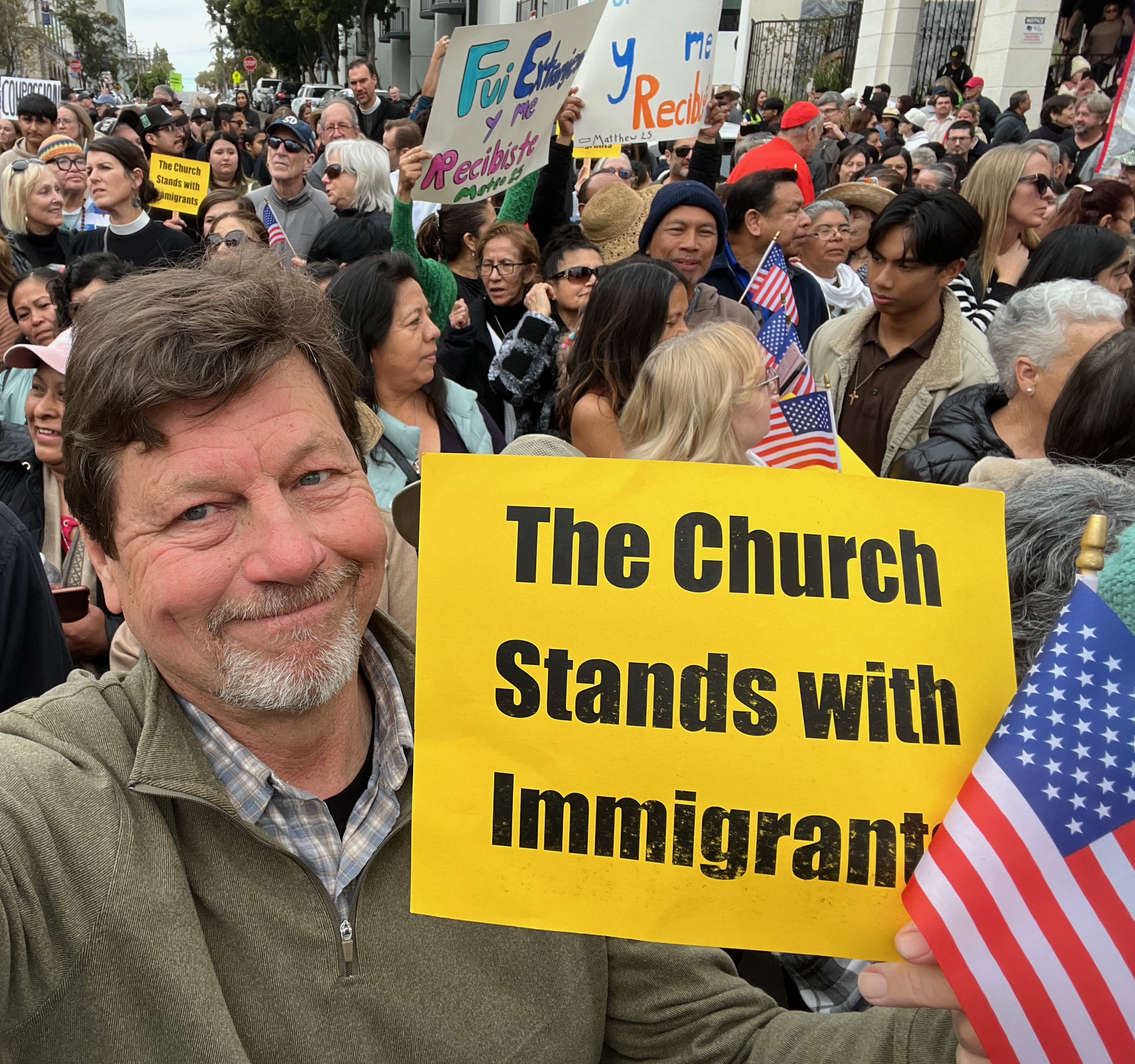
Did not Socrates say: "The undocumented life is not worth living"?

MISSING THE PARTY : The Journey of the Elder Son (Luke 15:11–32)

Sermon preached at St. Timothy Lutheran Church, San Diego (June 28, 2026) "Return of the Prodigal Son • Part 2  "MISSING THE PARTY...

Monday, June 29, 2026

MISSING THE PARTY : The Journey of the Elder Son (Luke 15:11–32)

Sermon preached at St. Timothy Lutheran Church, San Diego
(June 28, 2026)
"Return of the Prodigal Son • Part 2 
"MISSING THE PARTY: The Journey of the Elder Son" (Luke 15:11–32) 

Introduction: Return to Rembrandt’s Painting (17th c) 

Thank you for inviting me back for Part Two of the parable and painting.  I've enjoyed preaching the gospel and sharing my faith with you.  And the core of my faith is this conviction:   At the heart of the universe is a parental heart of unconditional Love; a Living God of Wisdom and Compassionate who desires healing and restoration of all creation, and will not rest until all God's people are home. 

Let’s look again at Rembrandt’s masterpiece. (slide 1) At least five figures — maybe others in the background. A platform where the central drama occurs in the spotlight. A darker platform with a dark divide between the two sons. 

Let’s focus on the shadowed figure to the right, which most commentators identify as the elder son.(slide 2).    He’s upright, composed, watching. His expression is hard to read: withdrawn, perhaps judgmental, perhaps something closer to longing. He stands apart from the reunion, hands clasped in a tight, controlled way, across a dark divide that Rembrandt painted deliberately. 

Last week we followed the journey of the younger son (back to slide 1): his rebellion, the far country, ruin, comes to his senses, returns home — met not with probation but with a robe, a ring, a feast. We understand that journey. A simple ‘lost and found’ story. 

And we understand something of Rembrandt’s own journey — from the reckless young painter of his early self-portraits to the old, humbled, half-blind man who finally got in touch with a tenderness and compassion to welcome a family member home. But today we consider the other figure. The one standing silently in the dark. The one who never left home. 

The Elder Son: Never Left, Lost at Home 

There’s something familiar about the elder son. His journey is a more complicated story. The elder son did everything right. While his younger brother was off squandering the family inheritance in reckless living, the elder son stayed home and held things together. He worked the land. He managed the estate. He kept the accounts, honored his father’s name in the community, and showed up day after day without complaint. Dutiful. Obedient. Faithful. Committed. His father relied on him completely. 

And yet — when the music starts and the celebration begins for his returning brother, the elder son is outside in the dark. And he will not go in. He never left home. But he lost his way. Lost at Home. 

How many of us know that way of being lost? Faithful, responsible, present — and yet somehow not quite at the party. Maybe you are the oldest child in your family; or grew up in a home where the older sibling was expected to be the standard-bearer while the younger ones seemed to get away with everything. Different expectations. Double standards. Not quite fair. It can breed resentment. And judgment. And sometimes a bitterness that can last for decades. There’s probably a bit of the elder brother in all of us. 

 I. The Elder Son’s Story: Coming in from the Field 

The Gospel text begins right at the peak of the father’s joy: “For this son of mine was dead and is alive again; he was lost and is found.” And then: “Now his elder son was in the field; and when he came and approached the house, he heard music and dancing.” (Luke 15:25) 

Of course he was in the field. Where else would he be? That’s who he is. While his brother was doing his thing and finding himself, the elder son was here — working the land, keeping faith, holding everything together. For years. Without recognition. Without reward. 

He hears music. Asks a servant what’s going on. When he learns that his brother has come home and his father has thrown a party, something hardens in him. He will not go in. 

The Father Goes Out to Him— just as he ran down the road for the younger son, now he comes out to find the elder son standing in the dark. 

And then we hear everything the elder son has been holding for years, finally said out loud: “Listen! For all these years I have been working like a slave for you, and I have never disobeyed your command; yet you have never given me even a young goat so that I might celebrate with my friends. But when this son of yours came back — who has devoured your property with prostitutes — you killed the fatted calf for him!” (Luke 15:29–30) 

 Notice how the younger sibling: “this son of yours” — not “my brother.” And how he identifies himself: “working like a slave” — feeling like a hired hand. Obedience without intimacy. Duty without delight. Earning what was always freely given. Hear the Father’s Word “Son, you are always with me, and everything I have is yours.” (Luke 15:31) 

 The father does not rebuke him. He does not defend the party. He simply reminds him of what has been true all along: You are always with me. You have had what your brother was starving for — presence, proximity, relationship — every single day. The inheritance was never at risk. Everything I have is yours. 

The elder son has been living in his father’s house as though he were a hired hand. He has had access to the feast all along and never claimed it. He has been so busy being faithful, he forgot that he was loved. And somehow the spirit of resentment got a hold of him. 

II. What Is Resentment--My Teacher Henri Nouwen 

My Teacher I want to tell you about my teacher, Henri Nouwen (you may have read one of his books). He was my major professor in seminary, and remained my teacher and friend all my professional life — a spiritual guide and model for how to be honest about the inner life. He was the kind of teacher who noticed you, and if you were struggling a bit and needed encouragement… (first lunch with Henri story) 

Fr. Henri Nouwen was a Dutch Catholic priest, a psychologist, and a professor of theology at Notre Dame, Yale, and Harvard. Then he left it all to become a pastor to people with severe disabilities at L’Arche Daybreak community in Toronto. One of the most widely read spiritual writers of the twentieth century. Here is one of his forty published books: The Return of the Prodigal Son. 

I’ve learned so much from him about Rembrandt, and about Jesus. Henri spent 3 days sitting with Rembrandt’s painting at the Hermitage, and meditating on this parable — and gradually recognizing himself in the portrait. Not only as the younger son, always searching for home in the wrong places. But also, as the elder son who was lost while still at home. 

Henri was in fact the eldest son in his Dutch Catholic family. Dutiful, obedient, careful to follow the proper path: called to the priesthood, he says, at age six. Ordained as a young man. Earned advanced degrees. A prestigious academic career as “priest-psychologist.” He did everything right. But never felt fully appreciated. Yet underneath all of that faithfulness, something was quietly accumulating that he could barely name. 

He finally wrote about it: “All my life I have harbored a strange curiosity for the disobedient life that I myself didn’t dare to live, but which I saw being lived by many around me. I did all the proper things, mostly complying with the agendas set by the many parental figures in my life — teachers, spiritual directors, bishops, and popes — but at the same time I often wondered why I didn’t have the courage to ‘run away’ as the younger son did.” — Henri Nouwen, The Return of the Prodigal Son, p. 70 

And then his deeper admission: “The more I reflect on the elder son in me, the more I realize how deeply rooted this form of lostness really is and how hard it is to return home from there. My resentment is not… [rational]. It is far more pernicious: something that has attached itself to the underside of my virtue.” — Henri Nouwen, The Return of the Prodigal Son 

Attached itself to the underside of my virtue. I have turned that phrase over many times since Henri first said it. The resentment doesn’t wear the face of anger. It wears the face of virtue (fairness, legitimate grievance). And that is exactly why it is so hard to see, and so hard to let go of. 

Resentment Is Cold Anger 

Henri defined resentment clinically as well as pastorally: resentment is cold anger. Hot anger, when we name it honestly, loses some of its power over us. But when we swallow those feelings — when we don’t name them, don’t express them safely — they linger. They harden. They become cold anger. Resentment. “Resentment, the curse of the faithful, the virtuous, the obedient, and the hardworking, settles itself in the human heart and causes havoc.” — Henri Nouwen, Home Tonight 

The curse of the faithful. Not the rebels, not the prodigals — they crash and come home and the party is for them. The ones most at risk are the ones who stayed. The ones who did everything right and watched someone else receive what they felt they had earned. 

Henri noticed this in himself with painful clarity. He said that at the very moment he wanted to act from his most generous self, he would find himself caught in resentment. Just when he was doing his best work, he found himself wondering why others didn’t give as much as he did. He called it the problem of the virtuous complainer. 

There is something strangely liberating about naming that. If the great Henri Nouwen struggled with the elder son in himself, then perhaps I need not be quite so ashamed of it in myself. 

[The Heavy Burden The Desert Fathers understood this. In the fifth-century Sayings of the Desert Fathers and Mothers, Abba John turned to his monks one day and asked: “Why don’t you throw off the heavy burden and take the light burden?” 

The puzzled monks asked what he meant. Abba John replied: “The heavy burden is judging other people, and the light burden is accepting the judgment of others.” — Abba John — quoted in Nouwen, Spiritual Formation, p. 97 Keeping score. Maintaining the ledger of who deserves what. Measuring your faithfulness against someone else’s failure. That is the heaviest load a person can carry. And it is exactly the burden the elder son has been carrying through all those years in the field.] 

III. What Is Gratitude? 

The opposite of resentment is gratitude. The word comes from the Latin gratia — favor, grace. Gratitude and grace share the same root, and that is not an accident. Gratitude is not counting your blessings or comparing yourself favorably to someone worse off. 

Henri described it this way: “Gratitude is the attitude that enables us to let go of anger, receive the hidden gifts of those we want to serve, and make these gifts visible to the community as a source of celebration. Gratitude is at the heart of celebration and ministry.” 

But here is where I want to go further than the self-help version of this teaching. Some people say: just choose gratitude. Just be grateful. And they mean well. But for many people in deep resentment, that counsel is unhelpful — it can feel like one more thing they’ve failed at. 

You cannot will your way out of resentment any more than you can will yourself to fall asleep. The harder you try, the more awake you are. Gratitude is not a switch you flip. It is a gift — not fully within our power to choose. 

The gift of gratitude, when it comes, is God’s to give. In God’s good time. 

IV. Moving from Resentment to Gratitude 

So is there anything we can do to loosen our hold on resentment and open ourselves to gratitude? Here is a simple three-step practice. It won’t get us all the way there by itself — only grace can do that — but it prepares the way. We can’t make it rain. But we can cultivate the ground. 

1. Name It 

The elder son names his resentment to his father’s face. All of it — the years, the labor, the lack of recognition, the goat never given, the fatted calf for the prodigal. He doesn’t stuff it. He says it out loud. 

[Personal Illustration]: To say outloud to God: “Listen! honestly: this is where I am. This is what I am holding…” That honesty — that naming — is the beginning of the journey. Not its end. 

2. Accept It 

This is what I’ve got in my hands. Maybe I’m holding it too tightly. But right now, it’s here — in my hands, in my gut — and I accept it. I own it. It’s mine. Acceptance is not resignation. It is not saying the resentment is right, or that the grievance isn’t real — it is. It is simply honesty about what is true right now. And it is the necessary step before surrender becomes possible. Acceptance is facing what is. With open hands, not clenched fists. 

3. Surrender It 

This is the hardest part. And the most important. We do what the 12-step tradition has always known: we admit we are powerless over this. We come to believe that a Power greater than ourselves could restore us. We make a decision — not to change ourselves by an act of will, but to stop defending the resentment. To release our grip. To say to God: I cannot move from here on my own. But I am willing. Make me willing to be willing. 

That is not the same as choosing gratitude. It is something more like surrender. It is standing at the door of the party and saying: I cannot make myself go in. But I am not going to walk away from the house. A simple gesture: turn your hands over. Palms down. Let what you have been clutching fall into the hands of God. And then — wait. Trust. Hope. Stay open. There may be something on the other side of that surrender. Joy. 

Joy and resentment cannot coexist. One of them has to go. And the invitation of the father — standing outside in the dark, beside the elder son — is the invitation to let resentment go, and move toward gratitude. 

As Reba McEntire often said to her friends in her old TV sitcom: "I've got just one word for you:  LETITGO. 

Or, as the 'hot Rabbi" in the current TV series "Nobody Wants This" advises his Gentile girl friend and others who are tempted to get angry or hold a grudge:  1) Accept, 2) Let Go, 3) Move On!  

Conclusion 

What happened to the elder son? Did he miss the party?  Did he come in from the cold?  Was he persuaded by the father to walk through that door? Did he sit at the same table as his brother? The Gospel doesn’t say. Rembrandt’s painting gives no clue. The elder brother’s story ends without resolution. Jesus leaves it open. 

The parable is addressed to everyone standing outside in the dark right now, hearing the music, feeling the cold. “Child, you are always with me, and everything I have is yours. Come in. You are home.” 

• We cannot make ourselves go in. But we can stay close to the door. 
• We can name what holds us back. 
• We can accept our humanness and our limited power to change. 
• We can be willing to be made willing. 
• [We can hope, and even pray, for the grace to exchange the heavy burden for the lighter one — and to receive the gift of gratitude in God’s good time.] 

One more thing. 

It’s not in the text, and Rembrandt doesn’t show it. But here is what I believe: 

The Father is not going back inside without us. The party is not a party until all his children are home.

Monday, June 22, 2026

"Two Hands are Better than One"--The Compassionate Father and the Prodigal Son (Luke 15 and Psalm 103)

A Sermon for Father's Day at St. Timothy Lutheran Church
(June 21, 2026)

There was a man who had two sons…” These two sons also had a mother. If it were Mother’s Day, I would preach on the motherhood of God — reflected in that remarkable image of Jesus weeping over Jerusalem, longing to gather her children like a hen gathers her chicks under her wings. (Luke 13:34) But since it’s Father’s Day, I want to focus on the Compassionate Father in the parable of the Prodigal Son.

One note as we begin. Martin Luther — who gave us the Reformation — famously struggled to pray the words Our Father who art in heaven. His own father was demanding and severe, and Luther carried that wound for years, seeing God more as judge and accuser than as father. Many people share that experience. If your father was harsh, absent, or frightening, the phrase Our Father can feel like a closed door. I want you to know: the father in this parable is not that father. And the God of Psalm 103, which we read together this morning, is not that God. 

The compassionate father depicted in the Psalm and in the Parable has been captured in one of the greatest paintings ever made. Take a look at the screen. I. Rembrandt’s Painting The Return of the Prodigal Son was painted in the 17th century, in the final years of Rembrandt’s life. (He died at 63). It hangs on a full wall of the Hermitage Museum in St. Petersburg, Russia — nearly life-sized, so you feel you are stepping into the scene rather than viewing it from a distance. You can see it here on the screen and printed in your bulletin. 

The canvas holds five figures. Which one do you most identify with? The younger son who went off to the far country? The older son who stayed home? The witness sitting nearby? The shadowed figures in the background? Or the compassionate father himself? 

The spotlight is on a humbled, kneeling son with broken shoes and a shaved head. He’s been through a lot in the far country— he no longer feels like he belongs. And yet he is still wearing his sword — the last sign of who he truly is. He is still his father’s son. And bending over him: the old man, the father. Eyes nearly blind from years of scanning the horizon, waiting. His massive red cloak spread around his son like the wing of a bird. Hands resting on his shoulders. Welcome home. 

To understand the painting, you need to understand the painter. As a young man, Rembrandt was wild and reckless — arrogant, extravagant, nearly impossible to live with. Over 63 years, he had squandered his wealth and lost his family: the beloved wife of his youth, three young sons, two daughters, a second partner… Lost… The masterpiece of his old age is a self-portrait — Rembrandt painted his own weathered face onto the compassionate father. It is the face of a man who has reached the end of his own pride, and who now understands something about grace he could not have understood in his youth. Finally, he has become the compassionate father. 

II. The Compassionate Father of Pslam 103

Psalm 103 presents a portrait of the Compassionate Father in three phrases: Our God is slow to anger, eager to forgive, deeply compassionate. 

Slow to anger — “The Lord is merciful and gracious, slow to anger and abounding in steadfast love.” That Hebrew word for steadfast love is hesed — lovingkindness, mercy that doesn’t quit. When you stumble, when you fail, when you disappear, the first movement in the heart of God is not fury and judgment. It is Love and Mercy. 

Eager to forgive — “As far as the east is from the west, so far he removes our transgressions from us.” “Buried in the deepest sea, yes that’s good enough for me…” — as some of us learned to sing in Sunday School. Too good to believe. But it is the gospel. 

Deeply compassionate — “As a father has compassion for his children, so the Lord has compassion for those who fear him. For he knows how we were made; he remembers that we are dust.” He knows our frame. He knows our limitations, our wounds, our need. His authority is always expressed by tenderness and love. 

And in the parable we watch all three qualities move through the story: The wayward son has come to his senses. He rehearsed his speech — Father, I have sinned against heaven and before you. I am no longer worthy to be called your son. Make me like one of your hired servants. But the father has been watching and waiting. 

And when he sees his son on the road— still far off— he doesn’t wait for the speech. He is filled with splanchnizomai — gut-level, visceral compassion, the kind that moves through your whole body before your mind catches up. And he runs out to meet him. He throws his arms around his child. He kisses him. And before the speech is given, he is calling out: the best robe, a ring on his finger, sandals on his feet, the fatted calf. Music. Dancing. Feasting. What was lost is found. What was dead has come back to life. 

No probation. No conditions. Rather, radical grace; and unconditional love, acceptance and forgiveness. Like the song we sometimes sing to God in worship? “You’re a good, good father. It's who You are, it's who You are, it's who You are. And I'm loved by You...” 
 

III. Two Hands 

Now look again at the painting —look closely at the father’s hands. They are not the same. The right hand is broad, strong, thick — you can see the pressure, the weight of it on the son’s shoulder. The left hand is smaller, softer, lighter — more tender. 

What I learned from my teacher, Fr. Henri Nouwen, is that the great Rembrandt, who knew grief and failure, dissapation and redemption, painted his masterpiece as a father with two kinds of touch. 

One hand is firm. It says: I believe in you. You can do this. You got this! The proverbial thumb in the back. The other hand is tender — lighter, open. It says: I’ve got you. You don’t have to earn this. Rest. 

A compassionate parent needs both. A marriage needs both. A family needs both. What I’m describing is a love that holds us in two ways at once: with enough strength to give us confidence, and enough tenderness to give us peace. When only one hand is raised, something essential goes missing. 

Illustration I — One Hand: Jack Lewis 

Last week I was in northern France, near the WWI battlegrounds where C. S. Lewis, author of The Chronicles of Narnia, fought on the front lines. I presented a paper at a Lewis conference there and shared a story about his father. 

A certain man in Ireland had two sons: Warnie and Jack (Clive Staples Lewis). Their mother died of cancer when Jack was nine years old — shattering their world. Their father Albert, an attorney in Belfast, raised his boys alone, with the help of a nanny and notoriously hard English boarding schools and regular visits home. Albert loved his sons, for sure. But he was emotionally limited — a man with one hand of blessing. He could provide. He could advocate. He could get things done. But the warmer hand — the hand of empathy, of emotional presence, of simply showing up — that hand was rarely raised. 

Both sons grew up and went to war in France. During the Battle of Arras on April 15, 1918, an artillery shell exploded beside Jack. Shrapnel tore into his chest, his leg, his wrist — one fragment piercing his lung. The sergeant standing next to him, a man [named Ayres,] who had become something of a father figure to Jack in the trenches, was killed instantly. 

At nineteen years of age, Jack believed he was dying too. He later wrote about that NDE experience with an eerie calm: “Just after I had been hit, I found — or thought I found — that I was not breathing and concluded that this was death. I felt no fear and certainly no courage. It did not seem to be an occasion for either.” No panic. No prayer. Just a young man observing himself from somewhere strangely outside the moment, taking note of the facts. 

Jack survived. Stretcher-bearers carried him off the field — not far from where I stood last week. He was eventually transferred to a hospital in Bristol, England to recover. And from that hospital bed he wrote his father a tender letter: I’m alive. I’m being cared for. I miss you. “I know that you will come and see me,” he wrote. “I was never before so eager to cling to every bit of our old home life and see you… Come and see me.” 

Albert wrote back promptly. He was relieved his son was alive. He assured Jack he was doing everything in his power to keep him from being sent back to the front — and as an attorney, he made good on that promise. He worked the system, he got things done. 

But he did not come. He did not come to visit. 

Weeks passed. Then months. After four months of requests, Jack wrote: “It is four months now since I returned from France, and my friends laughingly say that ‘my father in Ireland’ is a mythical creation.” 

I feel sad and sorry for young Jack. I wish his father had found a way to visit him. 

One hand. A strong hand, a caring hand. But one hand is not enough. Jack found the second hand he needed in a mother figure. One of his army buddies, (his name was Paddy Moore), had a mother who was warm, present, and emotionally attentive. 

The two young soldiers made a pact: if either of them died in battle, the survivor would care for the other’s parent. Paddy was killed in action. Jack kept his word, moved in with Mrs. Jane Moore and her daughter, Maureen, and they became the family he needed. The lighter touch. The second hand. 

Illustration II — Two Hands: Bill Presnell 

A more recent example — two hands of blessing, fully used. My friend and colleague Bill Presenll died last week at 91, after a long, good, and fruitful life as a minister, therapist, and family man. He was the best to work with — a mentor, and in many ways a father figure to me. His daughter posted a beautiful tribute this week: “Dad was a quietly intelligent, thoughtful, steady, calm and loving force in the lives of all who knew him. He was a beloved husband, father, stepfather, brother, Grandpa, great-grandpa, uncle, minister, mentor, and counselor who touched so many lives… And now we will all strive to walk forward in his way in love, just as he taught us.” 

And she named the quality at the center of all his relationships: He had an indelible gift for truly ‘seeing’ people and responding from the heart. Rest in sweet peace, Pop. We just love you to pieces.” 

Both hands. The steady, firm presence of a man who showed up — and the tender gift of someone who truly saw you and responded from the heart. Albert Lewis had one hand. Bill Presnell had two. And their children needed both. 

Conclusion:  Two Hands are Better than One

Listen. Most fathers fall short (including myself). Most of us have given more of one hand than the other — and most sons and daughters have needed more than their parents could give. Father’s Day is complicated. Not everyone here has easy memories, and not everyone had a father who showed up. That is real, and it belongs in this room. 

But what the parable and the painting together tell us is this: 

There is a Heart of Compassion at the center of the universe. A good, good Father; 
  • who is slow to anger, eager to forgive, and deeply compassionate 
  • who waits and watches the road, sees you coming from afar, and runs to meet you on the road. 
  • who looks into your eyes, hold your face in his hands, listens deeply, and sees you for who you truly are. 
His invitation is simply to come home. To kneel and receive the blessing of both hands. 
 
And to hear, in the silence of that embrace, the inner Voice of Love: "You are my son, you are my daughter. With you I am well pleased." 

May we hear that inner voice today, and learn to say with Henri Nouwen:    

“Here, I can kneel before my Father, put my ear against his chest and listen, 
without interruption, to the heartbeat of God.”—Henri Nouwen


Tuesday, March 10, 2026

Three Cowboys Walk Into a Bar...

Three Cowboys Walk Into a Bar…

Shawn is tipsy. John is not.

I had seen them both earlier that evening at the Red Dog Saloon and Bowling Alley on Mane Street while I was eating a brick-oven pizza made by cowboy Chris. Now we’ve crossed paths again down the street at Pappy & Harriet’s.

Pappy & Harriet’s is a legendary Western club where more than 200 people pack in most nights for music and special events. Over the years artists like Paul McCartney and Robert Plant have made surprise appearances on its small desert stage. Tonight there’s no live band—just a DJ spinning a playlist—but the place is still sold out.

Unable to get a table near the stage, I settle for a free bar seat in front of a television screen streaming the DJ at his turntable.

I’m glancing up at the screen and scrolling on my phone, minding my own business, when a voice behind me says:

Hey—I met you at the bowling alley. You said you’re from San Diego. I’m from Rancho Peñasquitos.”

He introduces himself as John. He’s out tonight with his best friend Shawn. Both are locals.

After some small talk John tells me he lives on fifteen acres in the desert in an old house his grandfather built. His grandparents had filed for the land back in the early 1960s under a homesteading claim—fifty dollars and some paperwork.

I love it out here,” he says. “I’ll never go back to San Diego.”

How old are you?” I ask.

Twenty-eight.”

Shawn is twenty-five.

I’m seventy-three,” I tell them. “Old enough to be your grandfather.”

John studies me for a moment.

You seem like a solid, stable guy,” he says. “What advice would you have for us?”

Shawn orders another drink and leans in, trying to follow along.

I pause and think: What do these guys actually need from me?

Well,” I begin, “how’s your 401(k) retirement plan?”

Neither of them has one.

My advice is to start a Roth IRA and max it out every year.”

They shrug. Neither seems particularly invested in the system. Maybe gold. Maybe silver. Definitely guns. Shawn tells me everyone has to watch out for themselves.

What else you got?” John asks.

I pause again.

Then I click into pastor mode.

Listen, guys. I’m going to leave in about fifteen minutes. So here’s my best counsel: Love your neighbor as you love yourself. That’s what the Good Book says.”

John leans forward.

Who’s your neighbor?” he asks, almost like he’s testing me.

Your neighbor is the person next door,” I say. “And also the person who ends up right in your path.”

John nods. He likes this.

Shawn does not.

You gotta look after Number One,” he says. “If you don’t look after yourself, nobody will. I mean, I’d take a bullet for John here. But you can’t rely on other people.”

He sounds like he’s speaking from experience.

Let me give you an example,” I say.

When you fly on an airplane, the flight attendant tells you that if there’s an emergency, oxygen masks will drop from the ceiling. First put your own mask on before helping others.”

They both nod—they’ve heard this before.

But the point isn’t to save only yourself,” I say. “You put your mask on first so you’re able to help the person next to you who might not be able to do it.”

John immediately agrees.

Shawn still looks unconvinced.

You need to go to church,” I tell him. “Go with John.”

John admits he was raised Christian and used to go to church.

Any good churches around here?” I ask.

Not on Sundays,” he says, “but there’s a Bible study on Wednesday nights that seems pretty good.”

He turns to Shawn.

Come with me?”

Shawn hesitates.

He tells me he wasn’t raised believing in God. It’s hard for him to believe. He’s not that interested.

Then he adds something honest.

I’d love to believe in God,” he says. “But I wouldn’t want to give up drinkin’.”

I laugh softly.

Don’t worry about giving up drinkin' right now,” I tell him. “Just take one small step in the right direction. Open your heart a little. Go with John this week. See what happens.”

John seems pleased.

Shawn remains skeptical.

Three minutes,” John reminds me, keeping track of the advice clock I set earlier.

So I stand up to leave. I remind Shawn that my name is Michael, and I was named after the angel Michael.  Your dear friend John is named after a disciple of Jesus named John.  Your name--Shawn--literally means: "God is gracious" or "Gift from God" and is the Irish derivative of the Hebrew name John. So you too are named after a disciple of Jesus!

I place my hands on Shawn’s shoulders, look him in the eyes, and pronounce a blessing over him:

The Lord bless you and keep you, Shawn.
The Lord make His face shine upon you and be gracious to you, Shawn.
The Lord lift up His countenance upon you, Shawn, and give you peace.”

Amen?”

I have no idea whether Shawn will remember this conversation or blessing in the morning.

But John stands up, smiles, and gives me a big bear hug.

As he leans close he whispers in my ear:

Thank you. I got this.”

At 11 p.m. I walk back to my van and settle in for the night, stealth-camping under the desert sky in Pioneertown.


Monday, June 9, 2025

A Sermon for Pentecost and Call for Action

Sermon for Pentecost 2025

Text: Mark 3:27

No one can enter a strong man’s house and plunder his goods unless he first binds the strong man.

Introduction: Season of Pentecost

Here we are gathered in the liturgical season of Pentecost—a time when the Church remembers the descent of the Holy Spirit upon the disciples and the unleashing of the apostles to bear witness to the Prince of Peace, Justice and Truth in the world. It is the season that celebrates the mightly acts of the apostles and the bold activism of those who follow their witness.  

Pentecost 2025 is a good season for Christian activism. A good season for holy boldndess. A good season to tell the truth. And a good season to remember what happens when the Spirit of God fills people with courage in a time of crisis.

A Prophetic Parable

The short parable about the strong man Jesus told in the Gospel of Mark is a little unsettling:

“No one can enter a strong man’s house and plunder his goods unless he first binds the strong man.”


Traditionally, this has been interpreted spiritually. The strongman is the devil, and Jesus is the one who binds him. While that is true, it’s not the only layer of truth. As scholars like Walter Wink and Ched Myers have shown, the “strongman” can also represent the "powers and principalities" of this world—spiritual evil clothed in political power.

Coded in a parable, Jesus was confronting the power of the empire—the Roman Empire—and the religious system that had made peace with it. He came to set captives free, but first, He had to bind the strongman in his house.

Three Signs of the Times

I want to name three converging trends in the present moment that call for binding the strongman.

  1. The growing resurgence of Christian nationalism. We are seeing a new form of militant Christianity fused with authoritarian politics, where political leaders are being cast not just as presidents, but as messianic figures—anointed by God, above the law, and surrounded by religious theater.
  2. The manipulation of religion to legitimize power. We are witnessing the same pattern seen in church history—when emperors converted for convenience, and when the church exchanged its prophetic voice for political favor. This is not new—but it is dangerous.
  3. The growing threat of state-sponsored oppression. Most recently, the administration has prepared mass immigration raids—intimidating municipalities, separating families, and framing immigrants as “invaders” and protestors as insurrectionists.  These are not isolated events but elements of a broader authoritarian agenda—and the church must not be silent.

History’s Warning: From Tolerance to Theocracy

I recently returned from an academic tour of historical church sites in Turkey, where the early ecumenical councils met in the 4th, 5th, and 6th centuries. We studied how Christianity was first persecuted, then tolerated, then legalized, then preferred—and finally made the official and required religion of the empire. The church first accepted the protection of the state, then courted its favor, and ultimately surrendered its independent authority to the rule of the Holy Roman Empire.

We are witnessing a similar slide today.

We are watching as religious leaders kneel in allegiance to political power, as scripture is used to justify domination, and as spiritual language is weaponized to impose control.

Binding the Strongman Today

 “No one can plunder the strongman’s house unless he first binds the strongman.”

Today, the strongman wears a suit, holds a Bible, and sit in the highest office of the land. But the fruit of his rule is fear, division, corruption, and cruelty. He has plundered the house—our democracy, our decency, our shared moral vision.

We must bind the strongman:

  • Legally—through the courts, through the Constitution, through accountability.
  • Politically—through protest, grassroots organizing, and the defense of democratic institutions.
  • Spiritually—through truth-telling, courage, repentance, and prophetic witness.

Call to Activism: 

The early church did not wait for permission to speak truth. On Pentecost, the Spirit came—and the Church was empowered.

We need a new Pentecost today:

  • Not one that is silent or safe.
  • But one that is bold and public.
  • A church that says no to fascism, no to fear, no to the worship of power.

If we wait until theocracy is official, it will be too late.

The Spirit is moving. The fire is falling. And the house is shaking.

Let us not be found among the fearful—but among the faithful.

Let us not bless the strongman—but spiritually bind him.

It's time to plunder the house—spiritually and politically-- to set the captives free.

Wednesday, April 16, 2025

An Easter Warning


There’s a strange and sobering feel to his Holy Week, borne of a convergence of sacred observance and civic unrest. Across the country, new rounds of protest are planned for Saturday, April 19. Here in San Diego, demonstrators will gather at Waterfront Park and march to the Gaslamp District to protest a wave of executive orders consolidating power in the hands of a single leader. The event is being organized by 5050california.org, under the banner “Not on our watch--because silence is compliance.” 

 Last Sunday was Palm Sunday—a day marking Jesus’s entry into Jerusalem amid cries of “Hosanna!” (save us!) and the waving of palm branches under Roman rule. Historically, it was not just a parade, but a protest march that led to his execution by the occupying empire. 

 This Sunday, April 20, is Easter—a day when Christians celebrate Christ’s resurrection. It is also the final day of Passover, when Jews recall the liberation of an oppressed people. But April 20 is also Hitler’s birthday, still marked by white supremacist and neo-fascist groups. This troubling convergence of symbols—resurrection, liberation, fascist memory—aligns with another political calendar milestone. 

 “On Day One”, January 20, 2025, President Trump signed an executive order declaring a national emergency at the southern border. That action triggered a 90-day period for the Secretaries of Defense and Homeland Security to assess the danger and submit recommendations on invoking the Insurrection Act of 1807, which allows the president to deploy military forces within the United States. That 90-day window ends on Easter Sunday. 

 No one can predict what Trump will do. But his followers interpret his actions through the optics and symbolism of power and providence. His movement has shown repeated disdain for democratic norms—denying due process, undermining free speech, and threatening judicial independence. If the military were activated against immigrants, protestors, or other “enemies,” it would mark not just an abuse of executive power, but a dangerous transition toward authoritarianism backed a military state. 

In San Diego—so close to the border and home to many immigrant and refugee communities—the implications are immediate. Many vulnerable residents are living in fear. Others are watching their retirement savings erode under the pressure of punitive tariffs. People of conscience are rightly alarmed by a torrent of executive actions concentrating power in the hands of a so-called strongman. 

 As a retired pastor, theology professor, and church historian, I believe a political reading of one of Jesus’s most poignant parables is warranted: “No one can enter a strongman’s house and plunder his goods unless he first binds the strongman.” (Mark 3:27) This Holy Week, we must ask: Who is the strongman now? And what powers must we resist in Jesus’s name? In context, to “plunder” is to take back by force what has been stolen. The strongman’s “goods” represent lives and resources captured by systems of domination and fear. 

Traditionally, the strongman is interpreted as Satan. But theologians like Walter Wink (Engaging the Powers) and biblical scholar Ched Myers (Binding the Strong Man) interpret the strongman as a political figure—a metaphor for imperial authority, embodied in emperors like Caesar. 

 Today, the strongman sits in the White House, surrounded by a weaponized team. As David Brooks recently wrote in The Atlantic, the Trump administration is “destroying any institution or arrangement that might check the strongman’s power.” The time has come to bind the strongman—legally in the courts, politically in Congress, socially through protest, and spiritually through prayer. 

 As a resident of Point Loma and church member in Ocean Beach, I feel bo th the tension and the hope of this crisis moment. On Good Friday, the Peninsula Faith Leaders will lead a peaceful, prayerful Pilgrim Walk along historic “Church Row” between St. Peter’s By the Sea and Resurrection Church OB (from Noon and 2pm on Sunset Cliffs Blvd.) —not as a protest or a parade, but as a demonstration of spiritual unity, community, and presence. 

 For me, Palm Sunday’s praise leads to Good Friday’s prayer walk, and into Saturday’s protest. Before I celebrate the resurrection on Easter Sunday, I will march with fellow San Diegans downtown. I will carry a sign that reads: 

 “Bind the strongman before it’s too late — Mark 3:27.” 

Michael J. Christensen, Ph.D. is a church historian, practical theologian, and clergy member of the Point Loma/Ocean Beach Peninsula Faith Leaders. He is the author of C.S. Lewis on Scripture; co-editor of Spiritual Direction: Wisdom for the Long Walk of Faith by Henri Nouwen; and other books on spirituality and social concern.


Travel